The judge’s description
He said one mark gave the appearance of blood and that an observer might have said: “There’s a bloody hand print on the wall.” He inferred wetness and a substantial quantity of blood.
The central issues
The case contains genuine evidential disputes. This page separates established records from expert interpretation, campaign allegations and questions that remain unresolved.
At trial and on appeal, the prosecution treated three wall marks as part of one event: a person with blood on their hands moving from Hilda’s bed towards the light switch. One mark, JH1, contained ridge detail attributed to Susan May. Attribution does not by itself establish the substance, date or circumstances in which that ridge detail was deposited.
The photo on the right was the only one used by the prosecution in its presentation to the jury. After the trial, the area shown in the photo on the left was tested for blood by one of Europe’s foremost blood experts. It tested negative twice and was discarded from further testing.
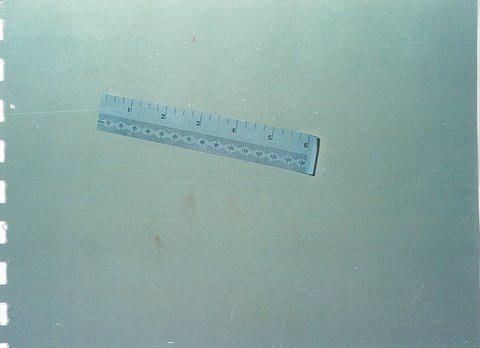
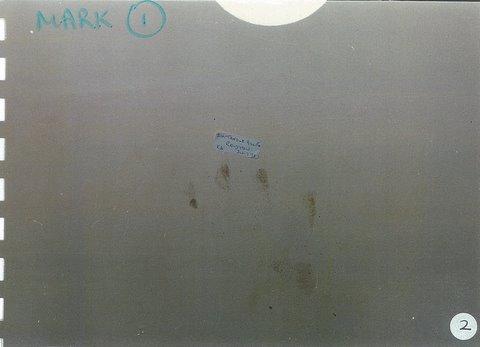
He said one mark gave the appearance of blood and that an observer might have said: “There’s a bloody hand print on the wall.” He inferred wetness and a substantial quantity of blood.
Geoff Goodwin argues that this language was stronger than the scientific findings justified, particularly when set against the faint unenhanced photograph, the different tests applied to different marks and later negative or qualified results.
The summing-up also recorded important qualifications: no test proved all the marks were human blood, there was no direct evidence that all three were made at the same time, and the marks might not have “hit you in the eye” when entering the room. Yet the judge later invited the jury to consider whether it followed that the marks were made together and were, on an “overwhelming probability”, human blood.
Hussain and Pounds’ 1989 scientific paper, The Enhancement of Marks Made in Blood With 3,3′,4,4′-Tetraaminobiphenyl, reported enhancement experiments on known bloodmarks. It did not provide a case-specific confirmatory test for the origin of the material on Hilda’s wall.
Several later specialists said TAB/DAB was presumptive rather than confirmatory and that a positive reaction should not be presented as proof that blood was present. Read the full reports by Allan Jamieson and Lydia Bossers.
The campaign records that the CCRC confirmed it could identify no other British court case in which this particular TAB method had been relied upon as it was here. The 2018 CCRC decision nevertheless accepted TAB as a presumptive test, acknowledged a greater false-positive risk in the likely one-step method, and decided that this did not create a real possibility that the conviction would be quashed. The campaign notes that this was at a time when the CCRC had admitted defeat and was considered by many to be “not fit for purpose”.
The records do not prove that every item was contaminated. They do identify routes and gaps that must be taken into account before treating later scientific results as self-explanatory.
Timothy Clayton recorded that when Hilda’s frozen reference sample was thawed, it began to leak badly. He said the leaked blood remained inside the first of three plastic bags. This is a documented leakage event and an important continuity warning. It is not, by itself, proof that another exhibit was contaminated.
A police policy document described Michael Rawlinson and another man as “good suspects”, while also recording a lack of evidence linking them to the murder. Rawlinson was a burglar with a history of violence and possible access to an orangey-red Ford Fiesta. Witnesses reported a red or maroon hatchback in the area.
A police action entry dated 27 April 1992 says tape lifts from a recovered Fiesta belonging to Rawlinson’s sister were in the Oldham exhibit office and had not then been forensically examined.
The CCRC later arranged a fibre comparison. It reported no link between the principal fibre populations on the car lifts and the scene or body samples.
A campaign submission says documents showing that the Fiesta had been found were placed in the wrong file and discovered by the CCRC after the appeals. That supports describing the material as misfiled and absent from the murder file. It does not yet prove that someone deliberately hid it. The CCRC’s account says relevant witness statements were disclosed as unused material; the available sources do not establish whether those statements were the same documents.
The proper public claim is that Rawlinson and the car were live lines of enquiry whose handling and disclosure deserve scrutiny. The records presently held do not prove that Rawlinson killed Hilda or that the recovered Fiesta was the vehicle seen near her home.
Mavis Brady, Hilda’s cleaner, was brought back to the house with police on 15 March. Yet the surviving reproduction of her statement does not record that officers showed her the particular wall marks or gave her the opportunity to say whether she recognised them. She was later brought to court and her evidence was used to support the claim that the marks were new. Silence in the statement is not proof that no conversation occurred, but the missing contemporaneous question matters.
Two preserved sources date her statement to 30 March 1992, not 27 April as one later campaign document claimed. At trial her evidence was qualified: she said she would try to remove visible marks, but she did not wash every wall and accepted that some existing marks could not be removed without damaging the paint.
Evidence policy: a missing record or conflicting recollection is not proof of fabrication, corruption or deliberate concealment. Those conclusions require evidence of intent.